
Rethinking Hybrid Collaboration
We look back on the project’s first year and present not only initial findings from our field research but also insights into the participatory development of our support tool, “NoticeLight-Meet.”
Concepts, Theory, and Research Practice
For many people, hybrid work has long been part of their daily routine. Our literature reviews, field observations, interviews, workshops, and surveys to date show that hybrid work is much more than just a combination of office-based and remote work. It is a unique form of collaboration that offers new opportunities for greater flexibility and inclusion in the workplace. Yet although video conferences, chat tools, and digital whiteboards are now taken for granted, new challenges continue to arise in the areas of communication, health, and social integration.
How can we, as an interdisciplinary research project, contribute to improving, rethinking, and effectively designing hybrid collaboration?
To gain an overview of the current state of research, systematic analyses of scientific publications were conducted at the outset. These analyses revealed that hybrid collaboration depends heavily on appropriate technologies—particularly when it comes to equal access to information and communication. In this context, it also became apparent that the scholarly literature does not use the term “inclusion” in its traditional sense. While our research team understands this to mean a greater integration of the perspectives of people with disabilities, in the context of hybrid collaboration, it refers to the inclusion of remote employees and how their overall well-being can be promoted [1].
An important theoretical impetus for the project was international research on hybrid collaboration. Rather than viewing hybrid work as a flawed hybrid of in-person and remote work, the so-called “third space” perspective highlights hybrid collaboration as a distinct, malleable sociotechnical space [2]. From this perspective, hybridity is not viewed as a compromise, but rather as a form of work with its own qualities and opportunities for shaping the work environment. Together with its partner, the University of Siegen (USIEG), Roskilde University (Denmark) organized an international symposium on this topic, at which the concept of the “Third Space” was further developed [3].
In general, our research on hybrid work raises questions regarding privacy, transparency, data protection, and employment rights. To ensure that we work in an “ELSI-compliant” manner and develop socially responsible innovation, internal ELSI workshops were organized under the leadership of the Institute for Work and Technology (IAT) team. During these workshops, the entire research team reflected on, among other things, design aspects such as professional proximity between researchers and employees, voluntary participation in studies, individual boundaries, and the burden imposed by technical systems.
Initial Findings from Field Research and Co-Design
The "NoticeLight-Meet" Platform and Its Systems
The NoticeLight-Meet platform (working title) aims to support hybrid meetings through new forms of interaction [4]. The following four concepts were developed to address the identified challenges of hybrid work. The (sub)systems are intended to be managed and used in various configurations via the central platform, as well as to be compatible with other commercially available applications to facilitate integration into existing work processes.
FlowCube
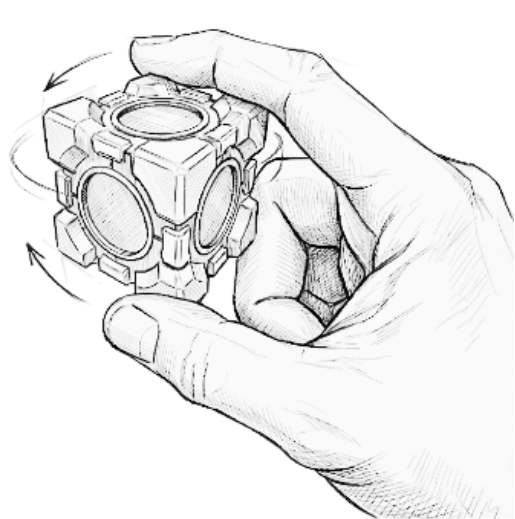
A tangible interactive object (e.g., a small cube) that allows meeting participants to easily communicate and perceive their level of engagement, mood, and requests to speak.
Meeting Globe

A small desktop device that enables peripheral, relevance-based participation in hybrid meetings.
Solar System
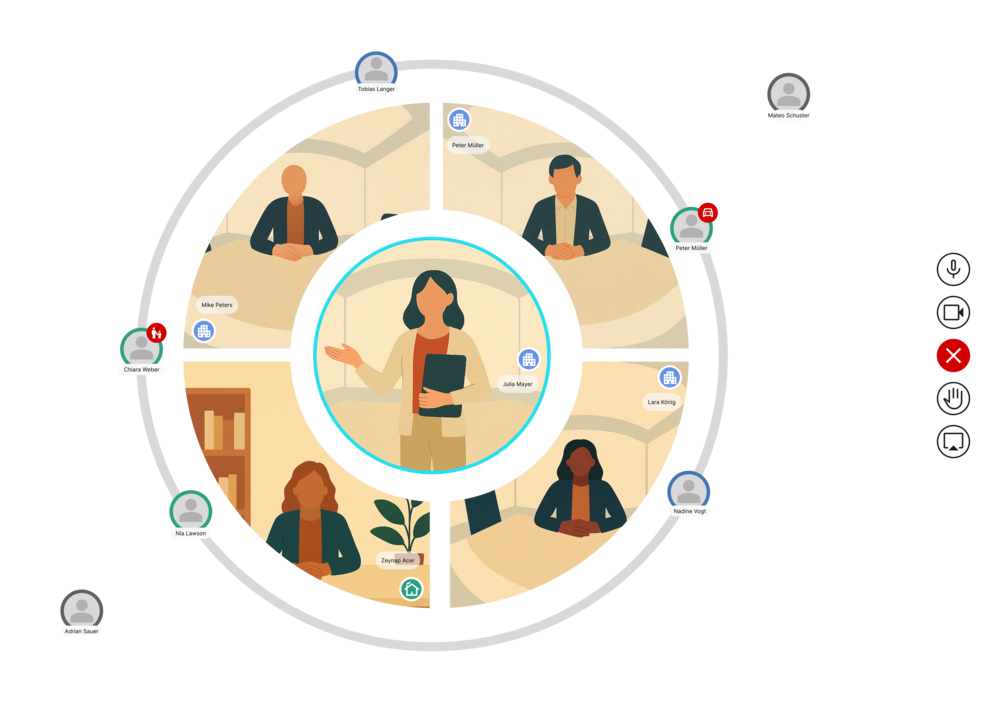
A new meeting interface for popular conferencing tools that displays the participation mode and context of all participants and fosters a shared understanding in hybrid meetings.
To better understand hybrid collaboration, real-world hybrid work situations were analyzed. To this end, the Work, Inclusion, and Technology (AIT) research team accompanied employees from various industries as they worked. Based on approximately 35 hours of field observations and interviews totaling over 450 minutes, the findings revealed that communication is at the heart of hybrid work. While spontaneous conversations and informal encounters are a given in the office, these interpersonal elements are often lost in a hybrid setting. Nonverbal cues in particular—such as eye contact, gestures, or spatial orientation—often have only a limited effect in hybrid meetings. This creates uncertainty about others’ attention, engagement, or participation, affecting both individuals and entire teams.
Over 500 minutes of interview data from the IAT also show that hybrid meetings are used in very different ways. Frequently cited benefits include flexibility and easier communication, while challenges include feelings of being “left out,” recurring technical issues, and parallel communication structures.
Hybrid meetings and related health aspects were examined in greater detail in a questionnaire study conducted by the IAT. Initial descriptive analyses and assessments point to specific advantages and disadvantages of hybrid meetings, although these still need to be verified through more in-depth evaluations.
The survey shows that the majority of respondents view their own health positively, with 65% reporting that hybrid work has a strong or very strong positive impact on their health. Approximately 70% of respondents rarely or never experience fatigue from remote participation compared to in-person participation. A key aspect is flexibility, which frequently leads to a better work-life balance for 70% of respondents. The ability to participate flexibly or only partially—including due to other commitments (whether personal or work-related)—is described in various ways in the open-ended questions and cited as an important advantage.
The results are preliminary and require further analysis to assess factors such as workload, exhaustion, and stress, as well as potential for reducing these burdens. Further analysis aims to provide a better understanding of these relationships, as hybrid meetings in particular have received little attention in such research to date.
The active involvement of users is essential for development and design processes. To this end, the IHRI and USIEG teams, together with their industry partner Colenet [1], organized a co-design panel comprising 13 individuals from agile work environments. Through two co-design workshops held so far, the group collaboratively identified and evaluated the potential of hybrid work and translated these insights into concrete design concepts.
In addition, short sessions were held at the Agile-Lean Conference in Munich [2] and Karlsruhe, during which participants exchanged personal experiences with hybrid work. On the one hand, positive aspects were identified; on the other, problematic experiences, individual workarounds, and solution strategies were shared. Visionary ideas for hybrid meetings in the year 2035 were also developed through role-playing exercises.
Based on insights from co-design and field research, the focus has shifted to the following aspects that shape everyday hybrid work:
- Role visibility is limited, and participation is unclear (e.g., facilitation, speaking, passive participation)
- Meeting overload hinders productive collaboration and increases mental strain
- Nonverbal communication, mood, and engagement are barely or not at all transmissible
To address these challenges, four concepts were developed: FlowCube, Meeting Globe, and SolarSystem.
To produce the physical system components, various manufacturing devices were purchased for a dedicated laboratory on the TU Dortmund University campus. These enable the IHRI team to develop their concepts through iterative processes, which is particularly important for interactive objects and wearables. The following equipment is available:
- 3D printers for iterations using the Fused Deposition Modeling (FDM) process
- Stereolithography printers, required for fine surface structures and translucent materials
- CNC milling machines, which enable subtractive machining and the fabrication of three-dimensional objects made of metal or wood, as well as the production of custom circuit boards required for electronics
- Laser cutters, for subtractive manufacturing and cutting sheets of wood, acrylic, and metal
- ESD workstation & soldering tools, necessary for the development and fabrication of control electronics
What's next?
The results to date make it clear that organizations cannot rely solely on technology to work successfully in a hybrid environment. Organizational structures, social practices, and a conscious approach to designing hybrid collaboration are also crucial.
The development of the NoticeLight-Meet platform and its systems has laid the groundwork for making hybrid meetings more inclusive, transparent, and human-centered. In the second year of the project, the focus will be on further technical refinement of the systems and testing their practical applicability.
In addition, we will examine hybrid work outside of scheduled meetings more closely to shed light on the challenges of spontaneous and ad hoc collaboration. The goal remains to design hybrid collaboration in a way that is not only efficient but also socially connecting and promotes well-being.
[1] Sellmann, Henrik; Reiz, Niko; Gerken, Jens; Mörike, Frauke (2025): Field-Based Research on Hybrid Work: Approaching More Inclusive Research Practices for Broader Perspectives? Mensch und Computer 2025 - Workshop Proceedings. German Informatics Society (Gesellschaft für Informatik e.V.). MCI-WS13: Embedding HCI in the Real World: Strategies for Recruitment and Field Research on Collaboration in Hybrid Spaces. Chemnitz. August 31–September 3, 2025. https://doi.org/10.18420/muc2025-mci-ws13-229
[2] Busboom, Juliane; Boulus-Rodje, Nina (2024): The Quest for “How to Do Hybrid Right”: Moving Beyond Compensating Asymmetries to Experience-Driven Cooperation. Proc. ACM Hum.-Comput. Interact. 8, CSCW2. 444, pp. 1–30. https://doi.org/10.1145/3686983
[3] Busboom, Juliane; Ringfort-Felner, Ronda (2026): Conceptualizing the hybrid space as a “third space.” Proc. EUSSET Conf. on Computer-Supported Cooperative Work. Siegen: EUSSET. Conference Paper. Munich, Germany. June 29–July 3, 2026. 10.48340/ecscw2026_ws02_01
[4] Altmann, Marie; Hegemann, Kimberly; Askari, Ali; Rallabandi, Vineetha; Pascher, Max; Gerken, Jens (2025): NoticeLight: Embracing Socio-Technical Asymmetry through Tangible Peripheral Robotic Embodiment in Hybrid Collaboration. Workshop on The Future of Human-Robot Synergy in Interactive Environments: The Role of Robots at the Workplace @ CHI-WORK’25, June 23, 2025, Amsterdam, Netherlands. https://doi.org/10.48550/arXiv.2506.22125